Post Mittwoch

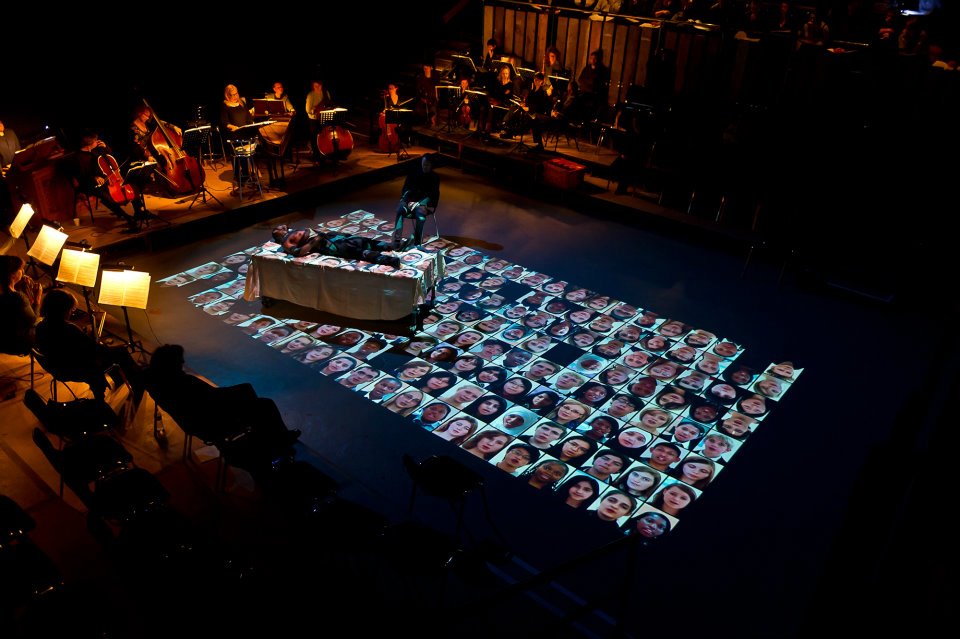
More than a month has passed since the final curtain fell on Birmingham Opera’s production of Stockhausen’s Mittcoch aus Licht, and yet it still occupies a significant part of my musical memory. You will have seen from the reviews I posted previously that the show was received extremely well, especially the World Parliament scene which I performed as part of Ex Cathedra. I think this extraordinary piece stood out from the rest because of its unexpected forces. For an audience to experience 36 unaccompanied voices singing predominantly ‘tonal’ music for forty-five minutes having just emerged from the darkness (literally) and electronic music of the Welcome must have been an extraordinary feeling.

For me, the six-hour show was a success because of these constant contrasts – not only musically, but also as a result of the production. There was always something to look at and marvel, wonder or laugh at. Musically, the constantly changing instrumental and vocal forces had the same effect of sustaining interest, and provoking thought and humor.

While there were several previews which created an expectation of the bizarre and even obscene from this piece, I think the audiences’ reaction was based on whether they could leave their Stockhausen preconceptions at the door as they entered the amazing cathedral-like warehouse space of the Argyle Works. This was a piece of extraordinary theatre that is unlikely to repeated any time soon and should have been enjoyed as such, not matter what ones thoughts about Stockhausen, his philosophies and his approach to music. There was only one very vocal heckler who was asked to leave the second performance, but even this is testament to the fact that this music is able to elicit a response in a time when contemporary music is doing no such thing.

The real joy of being involved in this production was of course the wonderful people whom I was lucky to work with. I’m looking forward to joining Ex Cathedra again later this year as they begin to prepare for Christmas with their Christmas by Candlelight programme. It was also a privilege to work with Graham Vick, who I believe is a true visionary, and his team who were able to make the whole thing happen.

@mittwoch2012

20120824-141845.jpgTonight is the penultimate performance of Stochhausen’s epic opera Mittwoch Aus Licht which is being produced by Birmingham Opera, in which I play a parliamentarian in the World Parliament scene performed by Ex Cathedra. While I intend to write more extensively about what an extraordinary experience this has been, in the meantime I thought you might be interested in reading some of the reviews which the show has received so far!

The Daily Telegraph
‘I was both exasperated and enchanted, bored and riveted. Best of all is the World Parliament scene: voluptuous, melismatic and polyrhythmic, it shimmers ecstatically … High praise is due to the director Graham Vick and his colleagues who have devised a flamboyantly imaginative and rigorously executed staging in a disused warehouse, to the superb instrumentalists and to the choirs of Ex Cathedra and London Voices. Whatever one’s ambivalence about the musical content, this is a magnificent show.’

The Guardian
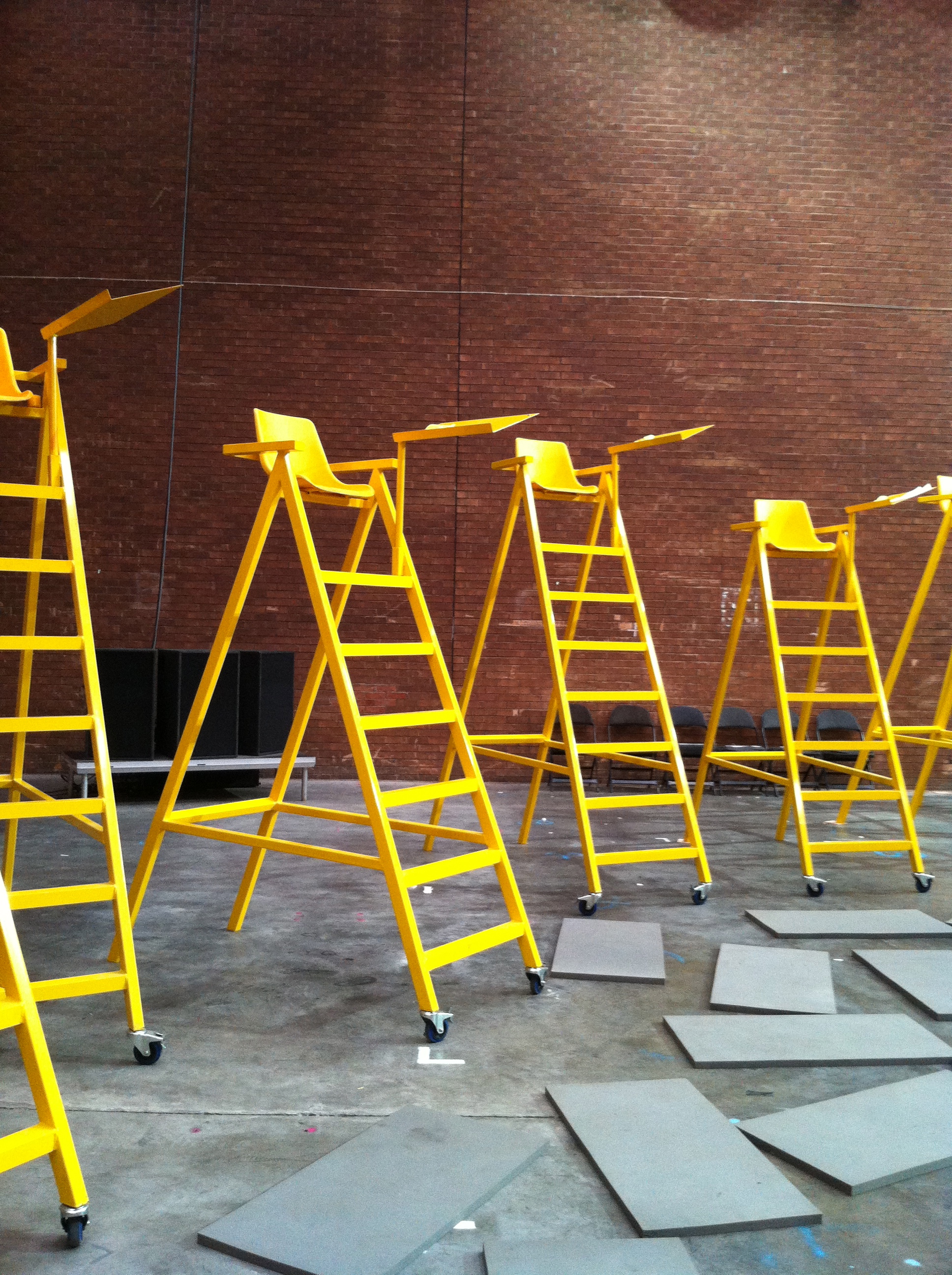
‘the extraordinary a capella World Parliament, wonderfully performed by the Birmingham-based choir Ex Cathedra perched high in umpires’ chairs around the edge of the performing space’

The Arts Desk
‘Ex Cathedra … ululated and chanted with immense power and precision, and conjured a sustainably captivating theatre from thin air.’

The Stage
‘Highlights include the virtuosic choral singing of Ex Cathedra in the World Parliament scene’

I should have posted this sooner, but to keep up-to-date with the rest of the action, why not follow me and others on twitter: @cpogorman, @mittwoch2012, @birminghamopera, and @excathedra.

Conductus at YEMF

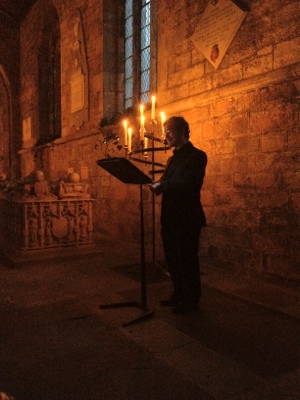
20120718-001440.jpgThis week has seen a return to music rehearsals for Stockhausen’s Mittwoch aus Licht with Ex Cathedra for Birmingham Opera Company, after an exciting appearance at the York Early Music Festival.

The York Early Music Festival hosted John Potter and I in the first live research output of Southampton University and Mark Everest’s AHRC funded Conductus Project – Cantum pulcriorem invenire. The performance took place in the beautiful All Saints’ Church on the Harewood House Estate late in the evening. The space was illuminated by candle light and the premier showing of Michael Lynch‘s beautifully evocative video. Thankfully there was enough light so as not to cause too many logistical problems when moving around the space during the performance, though John did have to use the torch app in this iPhone at one point.

Singing the Conducti in this space as a whole concert performance for the first time was a phenomenal experience. It was exciting to see how elastic we could be with the free texted sections, and exploring the juxtaposition of these against the rhythmic caude. I think the space encouraged us to explore the sound we were making too, with the resonance providing a sort of polyphony, especially in the solo numbers. The audience feedback was extremely positive with many fantastic comments about Michael Lynch’s film (during which, one of the horses tried to eat my head…). People also liked the fact that we didn’t take new notes between certain numbers, and that we were not static throughout, but moved around the space.

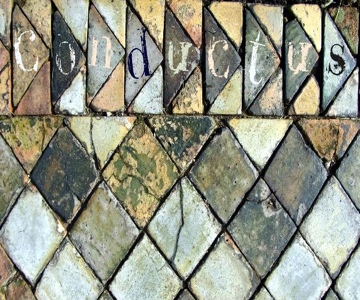
20120718-002457.jpgThe first recording, Conductus Vol I – Music & Poetry from Medieval France is being released by Hyperion Records in September and we are scheduled to record Vol II in January next year. With both CDs worth of repertoire under our belts, we hope to be able to perform more gigs during 2013.

Next week sees Stockhausen move into production rehearsals at the Argyle Works in Birmingham. The extensive music rehearsal time that we have already had for this piece has meant that we have been able to really get under its skin. Stockhausen (or his assistants) was so meticulous about his markings and it is impossible to overlook them. It will be very exciting to see Graham Vick’s vision for the piece on the stage. Unfortunately the shows are sold out, but hopefully there will be some media to show once the performances are complete.

NCEM Composers award 2012

Last month, the Ebor Singers were asked once again to take part in the National Centre for Early Music’s Composers Award 2012 which they hosted in conjunction with The Tallis Scholars and BBC Radio 3. Composers in two age categories were invited to compose a new choral piece with the Tallis Scholars in mind and using John Taverner’s In Nomine theme from Missa Gloria Tibi Trinitas as their starting point. From some 50 entries, seven were shortlisted for workshopping at the NCEM by the Ebor Singers with the composer Christopher Fox.

In the days running up to the workshop, the Ebor Singers had the luxury of three rehearsal sessions in order to learn the shortlisted pieces. This time was invaluable when it came to the workshop day because the singers were confident with corners which may otherwise have presented a challenge. All of the participants commented that they gained most from the workshop because of this preparation. There was a competence and performance confidence from where musical comments and adjustments could be made, rather than most of the time being taken up by singers grappling for notes as had been the experience at other similar events.

The workshops were fascinating from a singer’s perspective. Not only was it interesting to hear the many interpretations of the composer’s use of the source material – some very literal and others rather more esoteric – it was also fascinating to hear the various assumptions made by the composer’s when notating their work and vice-versa. As we have found in previous years, Christopher Fox is a fantastic facilitator in these situations. His charismatic, often ‘devil’s advocate’ approach, created a very interesting dialogue between composer, performer and ‘teacher’. The results of minor suggested amendments often had further reaching effects on the pieces overall.

The day culminated in a public performance by the Ebor Singers of all the workshopped pieces, recordings of which can be heard on the NECM’s website. These were then judged by Delma Tomlin (Director of the NCEM), Peter Phillips (Director of the Tallis Scholars) and Chris Wines (Senior Music Producer for BBC Radio 3). In her winners announcement, Delma highlighted that although there could only be one winner in each category, all who had made the shortlist had won in some way and will have inevitably gained from the experience of working with Christopher Fox and the Ebor Singers. The winners were Benjamin Rowarth (20) and Alex Woolf (16) whose pieces were performed by the Tallis Scholars in Durham Cathedral and will be broadcast on the Early Music Show later in the year.

As always, this competition proved that the future of choral composition – and by extension, performance – is in good hands.

Summer antics – Conductus and Stockhausen

After a much appreciated Easter break, The Minster Choir is now back to its full routine of services for the Summer Term. Even though this has just begun, I am looking forward to a busy summer of singing.

On the 10 July, John Potter and I will be performing the conductus programme live for the very first time as part of the York Early Music Festival. This will be accompanied by Mick Lynch‘s new video commissioned for the project. The performance will be largely based on the Conductus I recording (which is due to be released in the Autumn), but will also feature a sneak preview of new material in preparation for the second disk which we will be recording in November. John and I are meeting in All Saints’ North Street this week to begin exploring the new facsimiles.

During June, I will begin rehearsing for a Birmingham Opera Company production of Stockhausen’s final opera, Mittwoch with Ex Cathedra. This is the final work of his opera cycle Licht, and is being produced as part of the London 2012 Festival in August. The excitement of the project lies in the fact that it will be the first time that all six parts of the work have been staged together. It is an epic piece lasting some five hours and features two choirs, flying solo instrumentalists, live electronic and acoustic music and a string quartet streamed live from four flying helicopters. The performances will take place at the Argyle Works, a former chemical plant in the middle of Birmingham, and will be directed by Graham Vick.

Vocal Futures – the movie

Last year, I sang in the ABRSM sponsored chorus for a staged production of Bach’s St Matthew Passion, produced under the umbrella of Vocal Futures – the brainchild of Suzi Digby. This charity aims to involve and inspire young people to engage with classical music and this was their first major production. Through a number of workshops, young people (16-22) across the country were introduced to this gargantuan work and were allowed the opportunity to explore the music and to really get under the skin of the drama. The culmination of these efforts were displayed in the show as a Whitacre-esque virtual choir singing the final chorale, projected onto the stage.

The production was obviously aimed at a young audience, primarily those who took part in the workshops, all of whom were invited to the performances. It took place in a concrete bunker in the bowls of the University of Westminster, and the incorporation of sound effects and the virtual choir projections made for a multi-media performance – and that was before the visual impact of the stagecraft which was directed by Patrick Kinmonth.

It seems that this project is set apart from the myriad of other ‘outreach’ programmes by the fact that there is some follow-up for those who have taken part. Vocal Futures has a significant social media presence and there is an emphasis on encouraging the participants to continue attending live classical music concerts. This is supported by the regional hub network to which each of the Young Ambassadors (as the participants are known) belongs, which encourages further participation and debate. As an aside, their musical activity is being tracked for six months as part of a Cambridge University research project to build a picture of the concert going habits of teenagers.

The good news is that if you were unable to see any of the performances, it is being broadcast online on Good Friday. It is well worth a watch for the fantastic soloists and the amazing playing of the OAE who were on top form as well as for the stark and beautiful staging. If you’re still not convinced, here is a trailer to whet you appetite.

CAST

The red light syndrome

This week, the Minster Choir have been braving the cold, snowy York evenings to record their forthcoming Regent Records release. This experience led me to think about the art of recording and the psychology of being a performer in this situation.

While we are always striving to achieve the highest levels of communication with our audience, the very nature of the art means that each is only a moment in time never to be repeated in the same way again. A recording on the other hand preserves a single performance for all eternity, which will inevitably be judged and benchmarked. It is this thought that inhibits performers as they enter the studio. When the red light goes on, the noise is being captured no matter the quality. Of course modern recording techniques mean that recordings are rarely single performances, rather a patchwork of the best bits captured. But still the anxiety remains.

I have found recently however that this thinking can be turned on its head. Rather than being a daunting experience where tension is caused for fear of a bad take, the recording environment can be a space of freedom and experimentation. The ability to retake indefinitely (within the limits of the session) makes the whole experience more comfortable. One begins to relax and perform without inhibitions, and the result is a confident and exciting recording – one which may even inform subsequent live performances.

The lynchpin in any successful recording is always the producer. A great producer knows the capabilities and limits of their performer and encourages them to achieve their very best performance in front of an imagined audience of the future, within the inevitable time constraints imposed when recording. Their expert ears offer practical ways in which the performance can be enhanced, and their instant feedback offers immediate food for thought and often new insight into the music – sometimes to the extent that one feels as though they have been through an intense coaching session. The producer also has the unenviable task of editing the numerous takes together to create one patchwork performance; their impartiality a great asset.

All that remains now is to hear the first edit of this learning experience before its release into the wild.