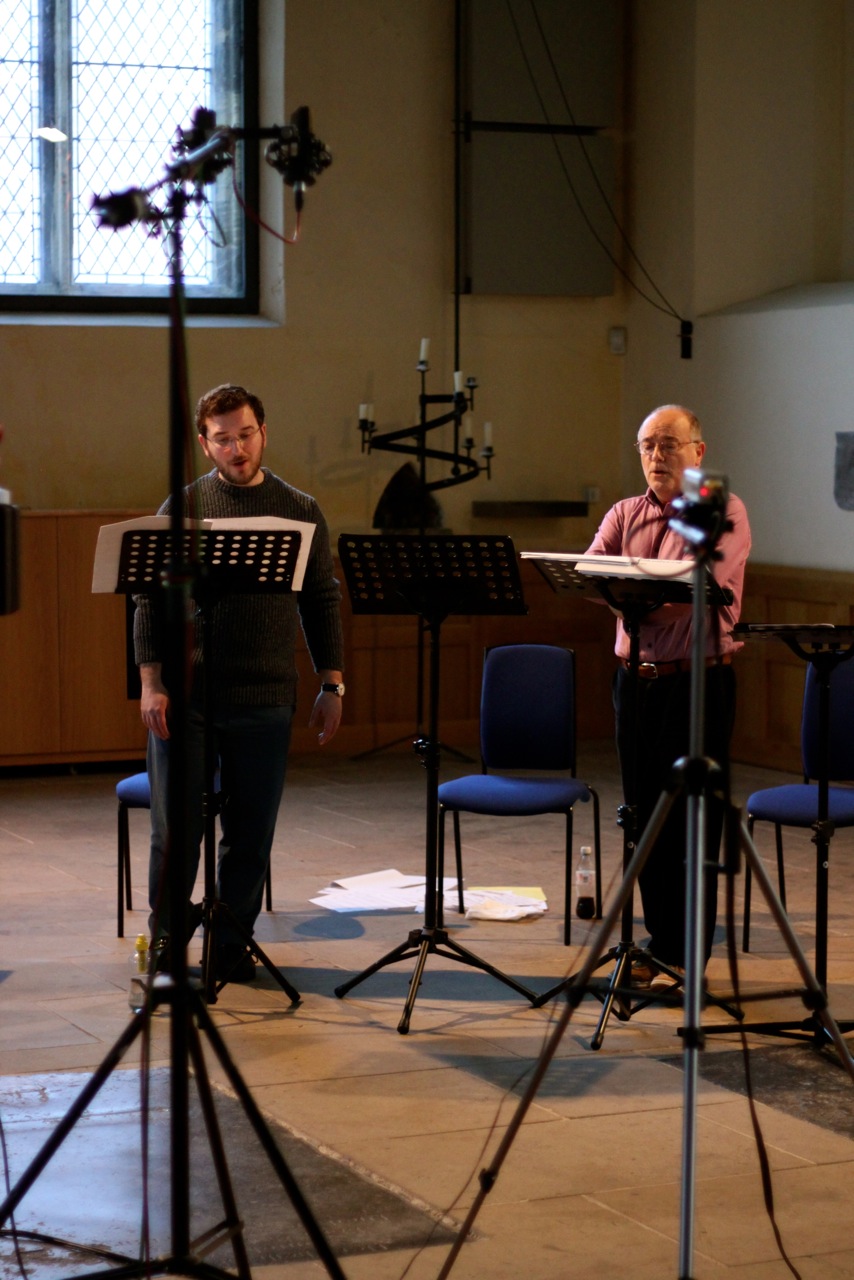
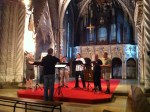
John Potter and I have been preparing for our concert in the Cambridge Festival of the Voice this week. The programme will be accompanied by Mick Lynch‘s film and includes a number of pieces from the second Conductus disk, due to be released later this year. We are performing at Emmanuel United Reformed Church at 8pm on Saturday (13 April). John and I will also be giving a short talk at 6:45pm about the programme, and discussing the various challenges we have faced when interpreting this music. We are also be attending a reception at Heffer’s Sound hosted by Hyperion Records. It promises to be a fantastic day. Full details can be found on the festival‘s website. Here is a short preview of the show which we grabbed while rehearsing at St Martin’s, Coney Street in York yesterday.
Rogers Covey-Crump, John and I had a fantastic photo shoot with Paul Arthur a few weeks back. Not only is he a fantastic photographer, but a great singer too. We all had a brilliant day, and the results are just what we wanted. Check out the Conductus page for further examples of his work.
I had a really fantastic time singing with the Ebor Singers last night in York Minster‘s stunning Chapter House. The programme included Ambrose Field‘s epic piece, Architexture I. It was fantastic to revisit this piece and to perform it in a new context, having only sung it the York Guildhall before. You can hear highlights of the first performance below.
Ambrose was also able to tell us about some potentially very exciting plans for the future, which I will share here as soon as I am able!
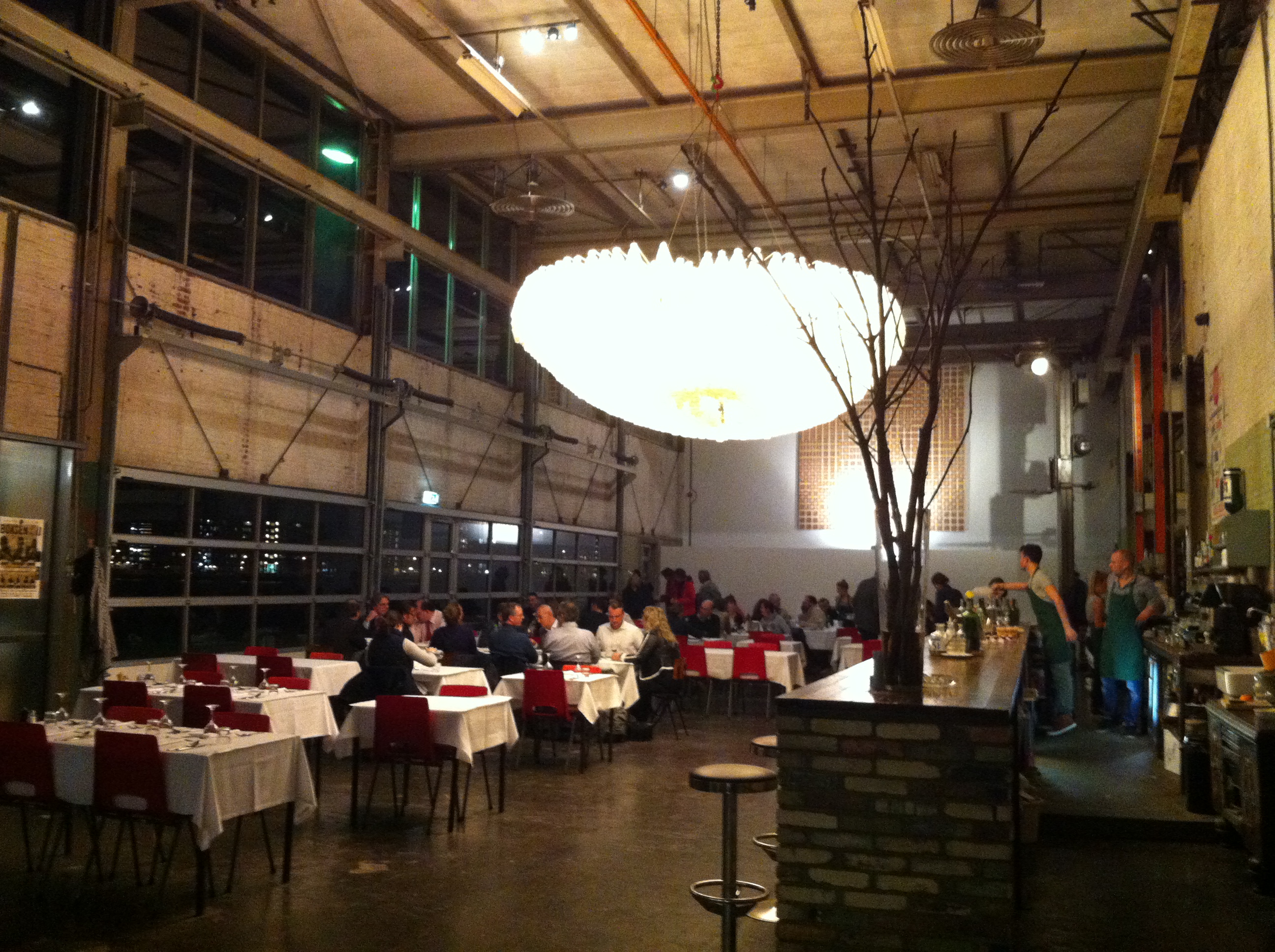
Last week, Mrs O’G and I were able to take a little time out and travelled to Amsterdam for a short ‘city-break’ where we were able to indulge our love of great food, cycling and (interior furniture) design. The city is stunningly beautiful and unlike many other capitals, is relatively compact and extremely laid-back. The city has so much more to offer than the sex and drugs for which it is infamous. And 2013 is a particularly bumper year too as the city celebrates several anniversaries; particularly 400 years of their canals, the re-opening of the Rijksmuseum and the 40th anniversary of Van Gough Musem to name but a few.
Although the Rijksmuseum and Van Gough Museum were closed due to extensive refurbishment (and will both re-open as part of these celebrations later in the year), we were struck by just how much other culture is available. Away from the large national galleries and concert venues are hundreds of quirky and unexpected experiences to be had. What was more refreshing was the lack of embarrassment in promoting this culture either. There was no hint of elitism, or any perception that this could ever be possible. Art seems to be for all who want to consume it, in whatever capacity. The dutch are proud of their heritage (as are most nations), but also recognise that the present is just as important. While history is preserved, this is not used as an obstacle in allowing the city (or the arts) to progress and adapt to changing times, tastes and fashions. There is also a spirit of adventurousness that is so lacking (in the arts particularly) in this country; there seemed little sense of a project having to make a financial return, but rather a mentality of being allowed the space to take risks for art’s sake.
Although we did not experience any live music while there, I imagine this excitement and spirit of adventure is evident in all art forms including music. A random-sample look at some local groups’ websites shows some very innovative and daring programming – particularly in the juxtaposition of early and contemporary music (and not the sort you plug just to get bums-on-seats) – as well as the public and private financial support offered. I do hope to be able to experience this sense of adventure from a performers point of view sometime in the future – hopefully I can find a way into the Dutch music scene!
Holiday over, it’s time to get back to work. The schedule for the Minster Choir is accelerating towards Easter. This year, as well as the build up to the wonderful music of Holy Week and Easter Day itself, we will also be performing Bach’s St John Passion for the first time in a long while. The soloists have recently been announced as:
The Ebor Singers also have a busy month as Easter approaches. They will be performing a Passiontide programme in the Minster’s sublime Chapter House on the 20th of March, and their now traditional performance of Stainer’s Crucifixion will take place on the 27th. They will also be participating in a hand-full of Lenten Compline services. Further details can be found here.
In April, John Potter and I will be performing the two-voice Conductus programme as part of the Cambridge Festival of the Voice. This will take place in the Emmanuel United Reform Church on the 13th and will feature similar repertoire to our YEMF appearance last year, as well as some new material from the forthcoming second disk. They will also be showing Mick Lynch‘s film which accompanies the programme, and John will be giving a pre-concert talk about the whole project. It should be an action packed weekend!
David Condry, Edward McMullan, Toby Young, Christopher O’Gorman
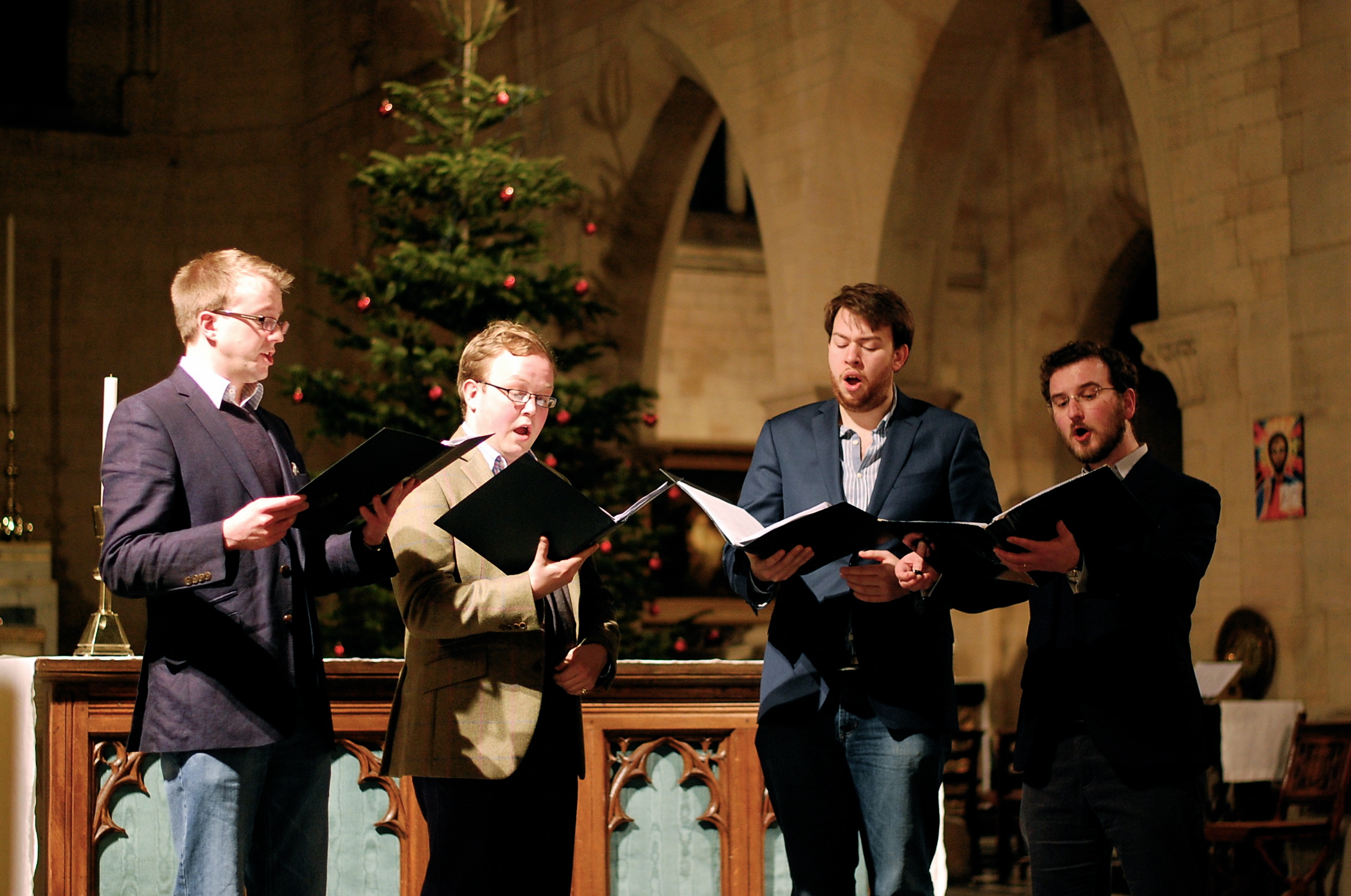
This week, I was delighted to have the opportunity to sing with two former colleagues (and friends) from the Minster Choir, and make a new singing friend, while rehearsing informally at All Hallows’, Gospel Oak. The aim of the session with Edward McMullan, David Condry and Toby Young was to explore the sound we make as a group with a view to singing together more frequently in the future. It was wonderful to take our time singing through a vast array of music from Perotin to Palestrina and Brumel to Bryars with a bit of Dowland thrown in for good measure, without the pressure of having to reach a performance goal.
It was fascinating how the choice of music influenced the way we sang. We were familiar with many of the styles of the sacred music chosen (if not the notes) because of our collective background in choral music within a cathedral/college setting. However, listening back showed that while we sang beautifully, the performance was not very exciting. When we began to sing secular music however, this became a while new ball game. We were no longer constrained by what we have been told for years is the correct way of singing a particular style and were able to take far greater riskes. The lesson learnt was that similar risks have to be taken in a small ensemble setting no matter what the repertoire.
The outcome of all of this is that it was an extraordinary musical (and social!) experience, and we are motivated to do more! Step 2 of the process will be to create a couple of programmes based on the strengths of the group that were discovered this week. Step 3 will then be to rehearse these thoroughly in the hope that we can (Step 4) perform them live in a variety of settings. The other crucial task between steps 3 & 4 is to come up with a name for the group which is currently affectionately know as ManChoir! Suggestions on a postcard…
The New Year has been filled with recordings so far. In early January, in this year of Benjamin Britten’s centenary, I was in London recording Britten’s War Requiem with the Gabrieli Consort. This disk will be the third in their Wratislavia Cantans Oratorio Series in collaboration with the festival of that name as well as the Wroclaw Philharmonic Choir & Orchestra and young singers who have been involved in the Gabrieli Young Singers’ Scheme. With such vast forces involved, one can image that the loud bits were pretty loud! However, Paul McCreesh also coaxed some exquisite quiet singing from the assembled masses. Although I have sung the piece before, I had forgotten how exciting Britten’s orchestration is. The brass fanfares in particular during the Dies Irae are mind-blowing – such evocative writing. The only downside to the sessions was that we didn’t get to hear much of the stella array of soloists; Susan Gritton, John Mark Ainsley and Christopher Maltman. I can’t wait to hear the final outcome!
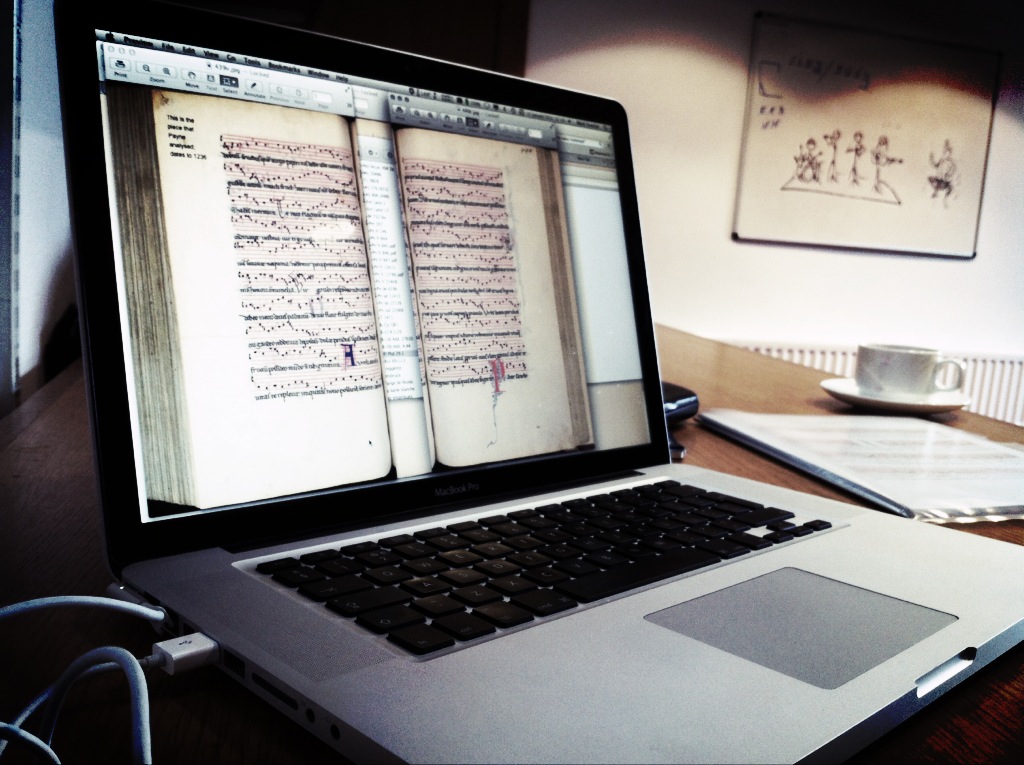
Then last week, John Potter, Rogers Covey-Crump and I returned to the National Centre for Early Music to record the second disk of the Conductus project for Hyperion Records. It was an intensive few days, but I think the results will be wonderful. Having made one recording already and performed the music live, we have definitely developed a collective sense of style. We have also got to grips with the editions which provide the performer with a mix of standard notation and clips of the manuscript. While I was sceptical about the time involved in preparing these scores for performance over the convenience of standard chant notation, I am now convinced that the results during performance are significantly different and worth the time spent with the manuscript. We could not have got the results we have without the amazing production and engineering skills of Jeremy Summerly and Julian Millard, and of course Mark Everist who was on hand to clear up any musicological questions. Thanks also to Mark’s team of musicologists in Southampton who prepared the editions.
John and I will be performing the two voice version of the programme with Mick Lynch‘s film at Trinity College, Cambridge on the 13 April during their Festival of the Voice. The first outing of the three voice version with Rogers Covey-Crump will be in Southampton in September with the video. Both programmes are also available as full length concerts with an interval but without the film and the repertoire will continue to develop for both as we prepare for the final recording. Further details are available on my Conductus page, or from Robert White (RWhiteAM@aol.com).
Finally, thanks to Stephanie Puzey Broomhead for braving the cold and snow with me this weekend to take some new promo pics which you will see popping up on the website soon.
After a few days rest following the London Quartet America tour, the busy run up to Christmas has begun. This was kick-started by my favourite service of the year at York Minster – The Advent Procession. The Cathedral begins in darkness, and as the evening progresses with readings and music, candlelight is spread from the west to the east of the congregation. It really is a magical experience. This stop motion film of last year’s service gives a sense of the effect.
The musical highlight for me was Sandström’s Es ist ein Ros’ entsprungen which was new to me. This is only the second piece of his that I have come across, the other being his completion of Purcell’s Hear my Prayer, but on the strength of these his work is definitely worth exploring further.
Our Minster commitment continues with the second of our Carol concerts taking place on Friday the 14th, two Nine Lessons and Carols services on the 23rd and 24th as well as the special services of Christmas Eve and Christmas day. For a full list of the Minster’s Christmas activities, visit their website.
I have also been singing with Ex Cathedra this month. They have a busy schedule of Christmas Music by Candlelight concerts, which are an inventive combination of words and music in several venues in and around Birmingham. As the name suggests, these are lit solely by candlelight, which can present a challenge when trying to read new pieces by the likes of Stephanie Martin, Panufnick, Esenvalds and Runswick. This clever programme not only conveys a beautiful sense of the meaning of Christmas, but also also manages to provide a retrospective of the choir’s activities of the past 12 months. Jeffrey Skidmore’s programme note sums this up perfectly. I am singing the programme four more times in Hagley (11th), St John’s Smith Square (13th) and St Paul’s, Birmingham (18th and 19th).
In addition, the Ex Cathedra Consort (solo voices) also had two concerts in York and Birmingham. These explored the rich Christmas repertoire of the South American Renaissance in the first half, and juxtaposed this with more familiar French and early English repertoire in the second. Both concerts were sold out to very appreciative audiences. In Birmingham, we had the opportunity to explore the incredible facilities of the new Bramall Music Building at the university with it’s stunningly flexible Elgar Concert Hall. This place really sets the president for departments where students are expected to pay up to £9,000 in tuition fees.
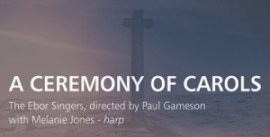
Still to come, The Ebor Singers will be performing their Ceremony of Carols programme in the Chapter House of York Minster on Saturday 13th. This year the Britten will be accompanied on the harp by Melanie Jones. The programme will also include the premier of Ian Colson’s Angelus pastores as well as new pieces by Campkin and Campbell. Tickets can be purchased via the Minster Box Office.
Finally, as light relief from all the Christmas stuff, John Potter and I met yesterday to rehearse the new music for Conductus Vol II which we will be recording in January 2013. It was fantastic to get back into the mindset of reading from manuscripts and it all felt surprisingly familiar. With the experience of the last recording as well as singing the Conductus live, I think the second recording experience is going to be a real pleasure. We also heard this week that there are a couple of concerts in the pipeline for 2013. I’ll post more details once they are confirmed!
As I said previously, I am still working on a new programme idea, so keep an eye on this new page for more details soon.
For the past 5 weeks, I have had the pleasure of touring with Cantabile – The London Quartet in the American Midwest. The tour encompassed 19 dates in different cities across 7 States (with a brief jaunt back to Germany for a show in Wunsiedel). As you can imagine, this means we covered several thousand miles in the car (6,700ish) as well as racked up 8 flights worth of airmiles.
Our programme was a celebration of harmony groups from the twentieth century through to the present day. This included songs by groups such as The Mills Brothers, The Manhatten Transfer, The Beach Boys, Billy Joel, The Comedian Harmonists and Prelude to name but a few. We also performed arrangements that have recently been published in TLQ’s Great British A Cappella Songbook!
The several challenges for me of performing this music began with having to memorise the majority of it. This is not something I have had to do very often and I found the thought rather daunting. However, after sever hours on my own and several more in a hugely supportive rehearsal environment with the group, I was able to crack it. Even with a dress rehearsal though, nothing can quite prepare one for the first performance off copy. It was an extremely exhilarating moment for me, and one that continued from show to show as we settled into it.
The show in Germany was a showcase for Peter Martin Jacos’ A Cappella Nacht where we shared the stage with the German group SixPack and The House Jacks from America who are credited as being the first a cappella rock group to use a beatboxer. Both of these groups were amazing; fantastic musicians and really brilliant entertainers. It was also really interesting to hang out with The House Jacks afterwards and find out about their various other musical activities. These are all very busy and influential guys, and it was a pleasure to meet them.
For me, the highlight of the whole touring experience was the people I was able to meet and work with along the way. It was fantastic to get to know Richard, Mark and Mike over an extended period and I look forward to drinking with them again in the future. It was also great to meet so many interesting and knowledgeable members of the audience, many of whom have followed The London Quartet for a number of years. I hope some of those who were newly introduced to the group will continue to support and follow them too. I certainly look forward to keeping in-touch with them and seeing what gems they have in store for the future. You can follow them on twitter @thelondon4tet and via their blog.
While on the road, I was also able to dream up some new projects of my own that I will talk about in more detail in due course. Do keep a regular eye on this news page and my twitter feed (@cpogorman) for some exciting announcements soon.
I am delighted to say that the Conductus Vol. 1 recording which was released by Hyperion in September has begun to receive some rather favourable reviews. Unfortunately not all are available online, but I have included some extracts below along with links to those that are.
Gramophone
There have been remarkably few recordings of the conductus repertory – those marvellous settings of mainly accentual Latin goliardic poetry from the years around 1200 … John Potter is one of the most experienced singers in the world for this kind of music and he is magically balanced by the glorious voice of the much younger Christopher O’Gorman. For the three-voice pieces the still impeccable Rogers Covey-Crump joins them … These are seriously classy performances.
What is, or are, conductus? The body of anonymous medieval songs, usually sacred but not liturgical and mostly forgotten, flowered in France in the mid-13th century around the time of the Notre Dame school. This new Hyperion disc … should reawaken interest in this beguiling repertory. The poems are about life, death, salvation and, naturally, the frail virtues of women. (“He who strives to keep and lock in a roving young woman/Is washing a brick.”) Three tenors – John Potter, Christopher O’Gorman and Rogers Covey-Crump – deliver these explorations with unerring skill and conviction
Classical Music Magazine
I found Christopher O’Gorman’s tenor, with a tonal spectrum wide enough to hold the interest without gilding the lily, very pleasing.
The tenors, Rogers Covey-Crump, Christopher O’Gorman and John Potter eschew effect, reverberation and atmosphere in this hour of highly satisfying singing. They favour substance. In the first place, every word, every syllable, is clear. Distinct yet gentle French Latin pronunciation is employed. They simply trust the honest exuberance of the conductus … and it works.
John Potter, Rogers Covey-Crump and I are heading back to the NCEM In January to record Volume 2 and will therefore have a substantial amount of material under our belts ready for live performance. If you are interested in booking a two or three voice programme, please contact Robert White Artist Management on RWhiteAM@aol.com.
I am very excite to be joining The London Quartet for their 2012 tour to America next week. This astonishing a cappella quartet have been delighting audiences since 1982, with a repertoire ranging from Madrigals to McCartney and everything in-between. The programme for this tour is called Harmony and Humour and draws on the songs of great vocal groups of the past including the Hi-Los, the Manhattan Transfer, the Crew Cuts and The Comedian Harmonists to name just a few. The tour will take in 19 shows across the American Midwest lasting just over a month.
Having had the final dress rehearsal for the show on Monday, I am now raring to get to America and sing with this wonderful group in-front of a live audience. I also look forward to meeting their supporters along the way.
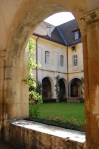
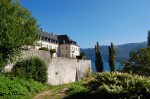
Recently, I was lucky to spend a long weekend singing with the Binchois Consort directed by Andrew Kirkman in the beautiful Abbaye d’Hautecombe in France. We performed a programme based around Anton Brumel’s parody mass on Josquin des Prez’s chanson Berzerette savoisienne. Brumel was employed as a musician in the Court of the Savoy around 1500 and it seems likely that the court spent time at Hautecombe during his employment.
Although I have sung Brumel’s Et ecce terrae motus with the Ebor Singers, I was unfamiliar with any of his other work. Philip Weller (who prepared the editions for these concerts) explained that while Brumel wrote a number of masse, mostly in four parts, only a handful have been edited and fewer are performed regularly. This seems a shame, since the quality of this music was so exceptional. Singing it with an ensemble of six solo voices was also an outstanding experience.
The experience of making wonderful music in this stunning setting was certainly enhanced by the generous hospitality we received from the Abbey’s current occupants who are all members of the Chemin Neuf Community. It was a wonderful experience and I hope to return in the future.
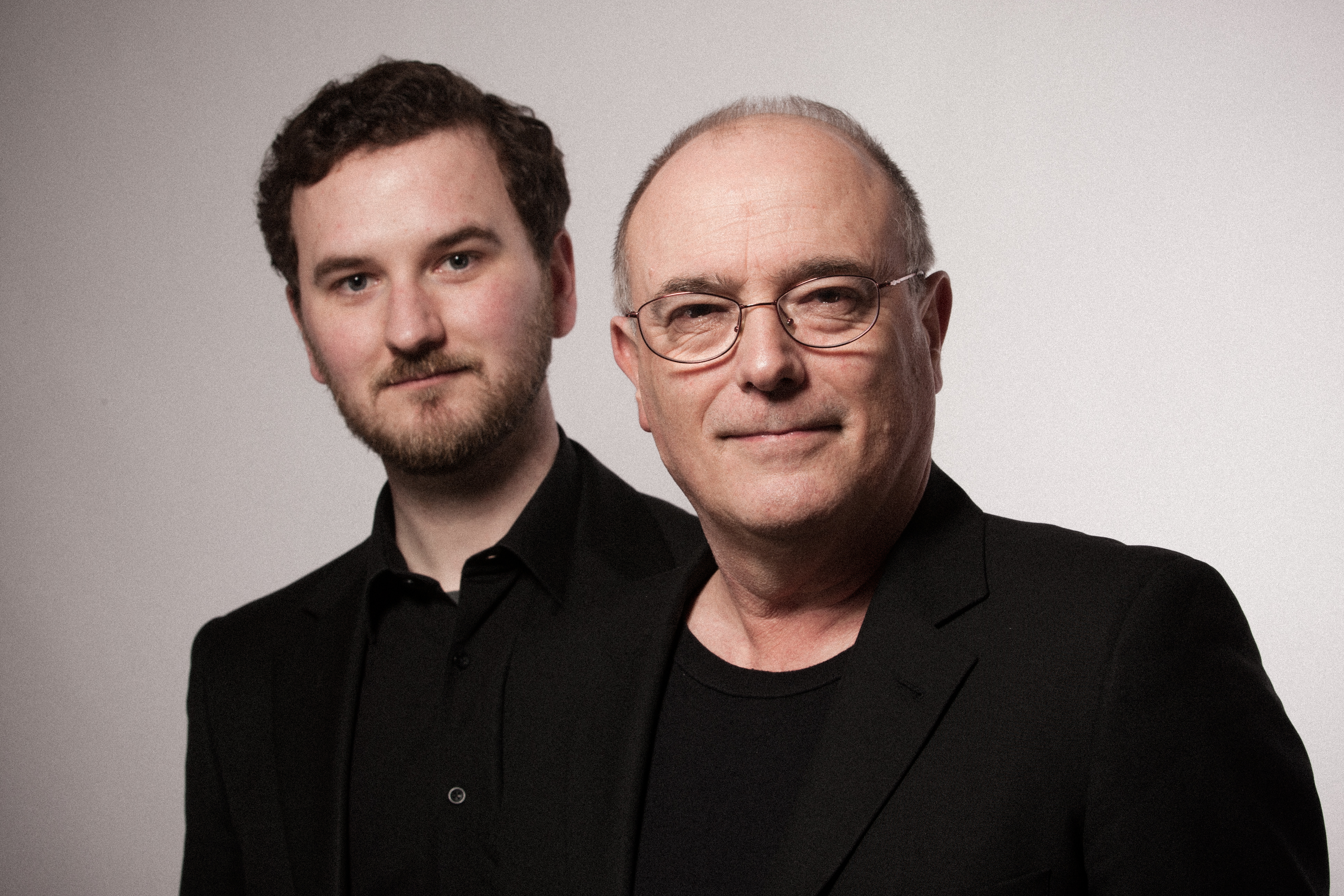 John Potter and I have been preparing for our concert in the Cambridge Festival of the Voice this week. The programme will be accompanied by Mick Lynch‘s film and includes a number of pieces from the second Conductus disk, due to be released later this year. We are performing at Emmanuel United Reformed Church at 8pm on Saturday (13 April). John and I will also be giving a short talk at 6:45pm about the programme, and discussing the various challenges we have faced when interpreting this music. We are also be attending a reception at Heffer’s Sound hosted by Hyperion Records. It promises to be a fantastic day. Full details can be found on the festival‘s website. Here is a short preview of the show which we grabbed while rehearsing at St Martin’s, Coney Street in York yesterday.
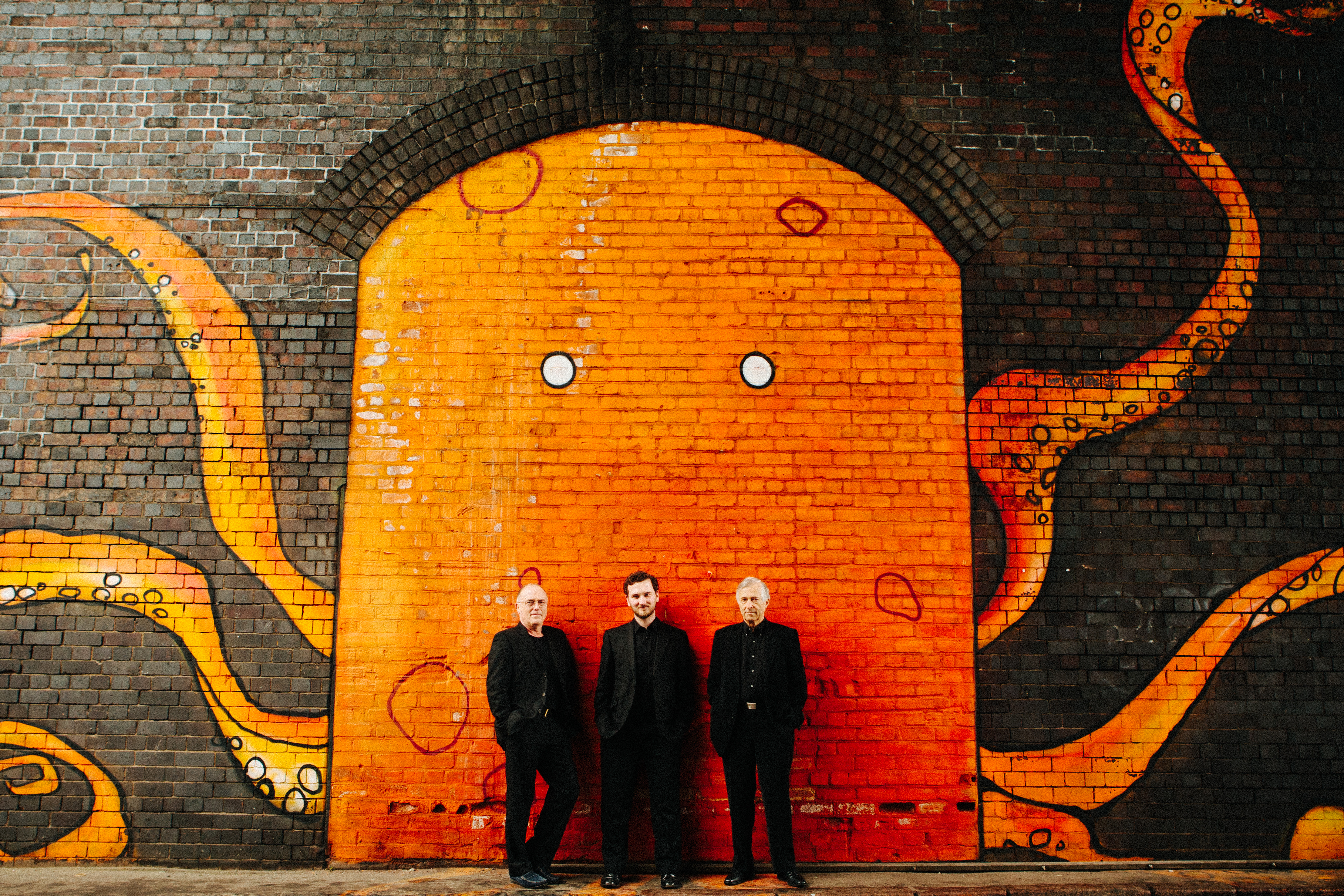 Rogers Covey-Crump, John and I had a fantastic photo shoot with Paul Arthur a few weeks back. Not only is he a fantastic photographer, but a great singer too. We all had a brilliant day, and the results are just what we wanted. Check out the Conductus page for further examples of his work.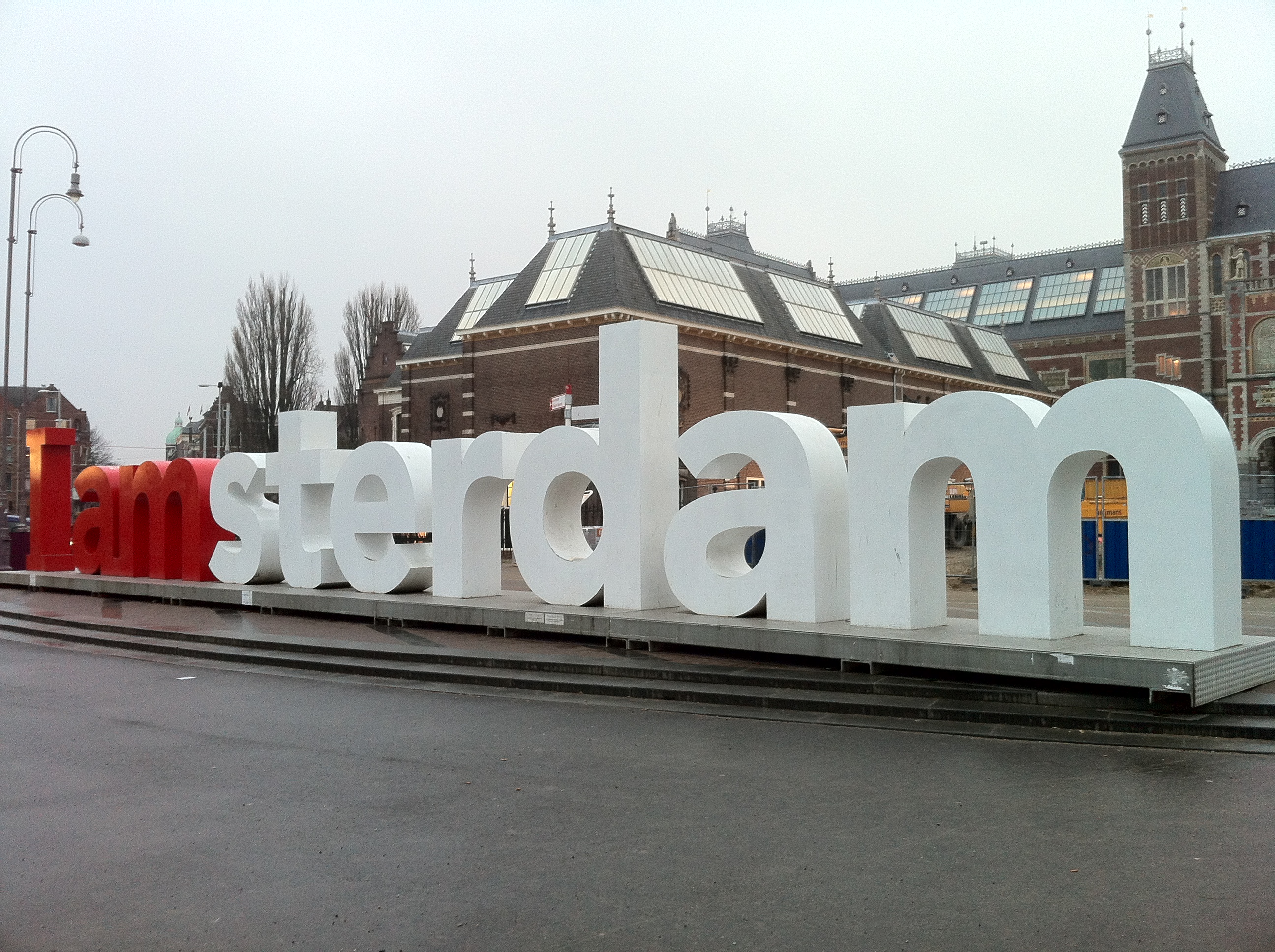









 Christopher O'Gorman - Tenor